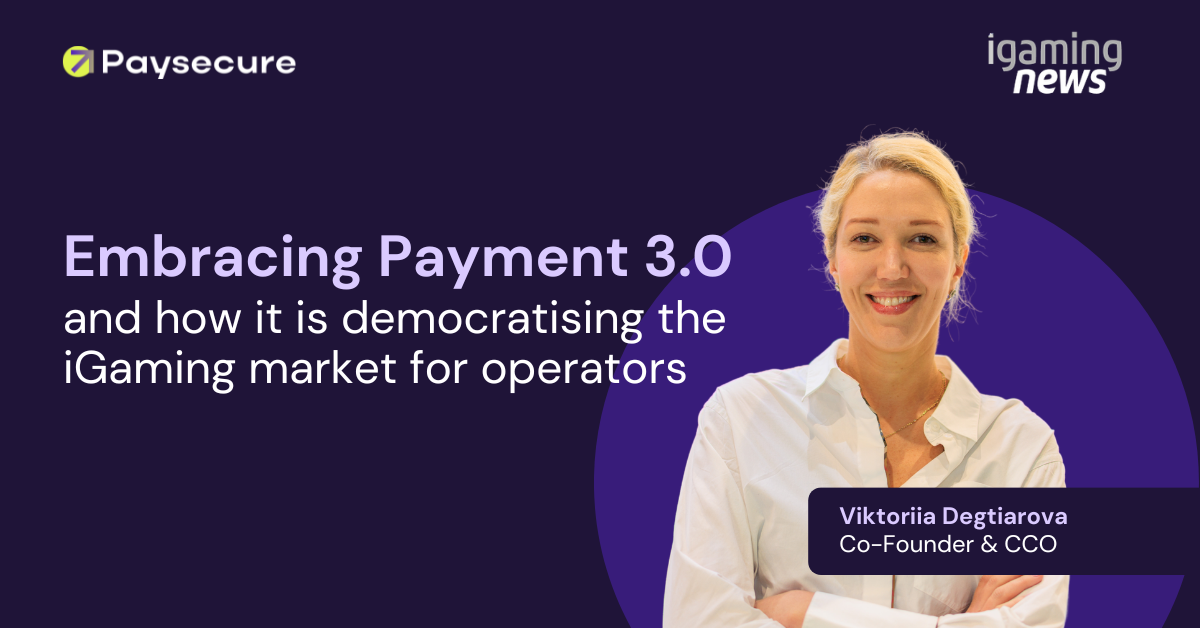
First featured exclusively in iGaming News
Digital payments are evolving. We are moving beyond the era of Payment 2.0 and stepping into the age of Payment 3.0, a transition that promises to redefine how merchants, retailers, and operators of all sizes compete, convert, and thrive. For high-risk sectors like iGaming, this isn’t just a technical upgrade; it’s an opportunity for future success.
Payment 2.0 vs. Payment 3.0: The crucial difference
To see where we are going, we must first look back. Digital commerce began with Payments 1.0, focused on basic connectivity. In the early days of the internet, the experience was static and functional, with few pioneering merchants and limited digital payment options that simply mirrored traditional mail-order processes.
This transitioned into the current Payments 2.0 landscape, defined by the rise of mobile apps, card networks, and centralised intermediaries like PayPal and Venmo. While this era introduced massive convenience and social interaction, it remained tethered to centralised architectures. Here, banks and big-tech platforms act as gatekeepers, controlling user data and charging fees within a framework that, while functional, often suffers from systemic risks such as data breaches and the inherent friction of legacy banking infrastructure.
Payments 3.0 represents a fundamental shift from these corporate-controlled systems toward a decentralised, user-centric ecosystem powered by blockchain, smart contracts, and ISO 20022 standards. While Payments 2.0 was about the app-based convenience of routing a transaction from point A to point B, Payments 3.0 moves beyond mere movement to encompass true programmable value.
In this new paradigm, orchestration has evolved from a tool for optimised automation into a sophisticated engine of real-time intelligence. It is no longer just about finding the most efficient path for a payment; it is about leveraging a wealth of live data to make the payment process a leading competitive advantage. This orchestration layer acts as the brain of the transaction, utilising AI-enabled tools to analyse and act upon data the moment it is generated, ensuring that payments are not only instant and global, but also deeply integrated into the digital identity of the user.
The true hallmark of Payments 3.0 is this symbiosis between decentralised architecture and intelligent orchestration. By removing traditional intermediaries, the focus shifts entirely to the strategic use of data to enhance security and efficiency. Orchestration originally started as optimised automation between payment providers. Now, by using intelligence gathered at the payment stage, it has become a leading competitive advantage for any company looking to reduce costs and mitigate risk.
Unlike the rigid structures of the past, modern orchestration platforms, such as Paysecure’s solutions, use real-time intelligence to empower users to tailor their customers’ customised payment journeys. Congruently, AI can monitor risk while the platform optimises liquidity flows across diverse networks. This gives firms ultimate control over their payment journeys, matching the power of data and AI with real-world customer experience.
The decentralised nature of Payments 3.0 also signifies the fragmentation of the payment industry, which is particularly prominent when firms deal with players all over the world at a variety of value levels. This means companies either build their own all-in-one solution, which can be costly and limit future expansion, or buy a solution that joins up all parts of the payment journey within one platform. Paysecure, for example, is pioneering this shift toward scalable, modular, API-first platforms that replace the old model of monolithic, costly in-house builds. The defining differentiator is the move from fragmented point-solutions to a unified, data-driven, and resilient ecosystem, shifting the payment function from a necessary cost to a core competitive advantage.
This transition signifies that payments have moved from a back-office necessity to a foundational technology. In this era, the ability to harness real-time data and respond with automated, AI-driven precision is what differentiates a simple transaction from a transformative financial experience, putting intelligence at the heart of the modern payment landscape.
The impact on iGaming operators
The igaming sector is high-volume, high-risk, and intensely competitive. It’s the perfect test for Payment 3.0. The survive-or-die pressure to perfect the payment stage, the single most crucial conversion moment, has already forced operators to pioneer the solutions that underpin Payment 3.0: payment orchestration.
Payment 3.0, powered by orchestration, directly combats revenue leakage and maximises conversion. Across all sectors, 62% of customers who experience a failure at the payment stage of a transaction will not complete a purchase. Orchestration addresses this by using smart routing to instantly retry a soft-decline or legitimately looking transaction with a different acquirer, thereby saving the sale. In sectors where payments can fail for a myriad of legitimate reasons, this can be a crucial step in converting previously lost customers.
This functionality, known as redundancy, creates payment infrastructure resilience. Paysecure’s solutions, for example, have increased transaction approval rates by up to 7%. Smart routing, which can be triggered by factors like location, payment method, or BIN number, allows businesses in these sectors to customise the journey for individual customers in real time to ensure the most seamless transaction experience possible. This includes the cashier stage, where the routing engine can adapt quickly if there is a failover or retry trigger, ensuring customers don’t feel the friction in the process. After all, they don’t need to know what’s happening “under the hood,” they just need the confidence and security that their payment can be made safely and securely.
To succeed globally, a business must be hyper-local. Research shows 99% of cross-border shoppers expect to pay with their preferred, customary methods. In many emerging markets, over 75% of online purchases use local payment options, not international credit cards. Orchestration gives operators the data to make payment journey decisions that maximise conversion and reduce transaction failure rates. By being the central hub, orchestration empowers firms to hyper-personalise offers, provide VIP workflows, and introduce features like click-to-pay that improve customer experience.
In the market, Paysecure uses real-time intelligence to perform Smart Routing, ensuring each payment is directed to the specific bank or processor most likely to approve it based on variables like the customer’s location, card type, and historical success rates. If a technical failure occurs at the primary bank, the system’s cascading logic instantly retries the transaction through an alternative provider, ensuring the customer never encounters an error message, increasing conversions.
Beyond technical routing, Paysecure leverages AI-driven behavioral intelligence to create a User Trust Score for every shopper. By analysing device fingerprints and payment history, the platform can distinguish between high-risk actors and loyal customers. This allows merchants to offer frictionless checkouts and remove time-consuming security steps like 3DS for trusted users, while automatically applying stricter filters to suspicious ones. This data-driven approach significantly reduces cart abandonment by removing unnecessary hurdles for legitimate buyers, crucial for iGaming approval and retention rate improvement.
Democratising power for scaling operators
Historically, orchestration was the industry’s best-kept secret, only available to the largest players who could build it in-house. The final barrier was financial, not technical.
Payment 3.0 fundamentally changes this by democratising the infrastructure. The old model of inflexible, costly in-house builds is replaced by scalable, modular, API-first platforms. Modern orchestration providers, such as Paysecure, are making this top-tier technology accessible to all operators, not just market leaders. By offering scalable, modular solutions with no prohibitive upfront costs, the playing field is leveling. Scaling and challenger igaming operators can now access the same best-in-class, smart-routed infrastructure, deep analytics, and custom-built tools as a global giant. This removes prohibitive upfront costs, letting firms compete on customer experience, not just balance sheet size. Furthermore, challenger operators are often more agile and can use deep data and insights faster than larger organisations. Fast adoption is key, allowing challenger iGaming operators to quickly gain a competitive edge.
The igaming sectors serve as the ultimate proving ground for payment 3.0 technology. Being internationally facing, ultra competitive, and previously underserved by the major payment providers, iGaming operators and merchants in these sectors have an opportunity to utilise the latest and greatest payment technology to get the edge over their competitors, regardless of the sector they are operating in and the size of the competition. These solutions which have been created out of necessity are now available to all. Payment 3.0 is not a futuristic concept; it is the present reality of payments, empowering every merchant to build a personalised, resilient, and high-converting payment journey.