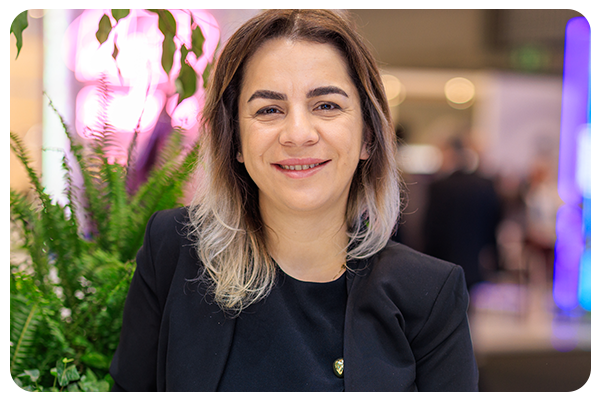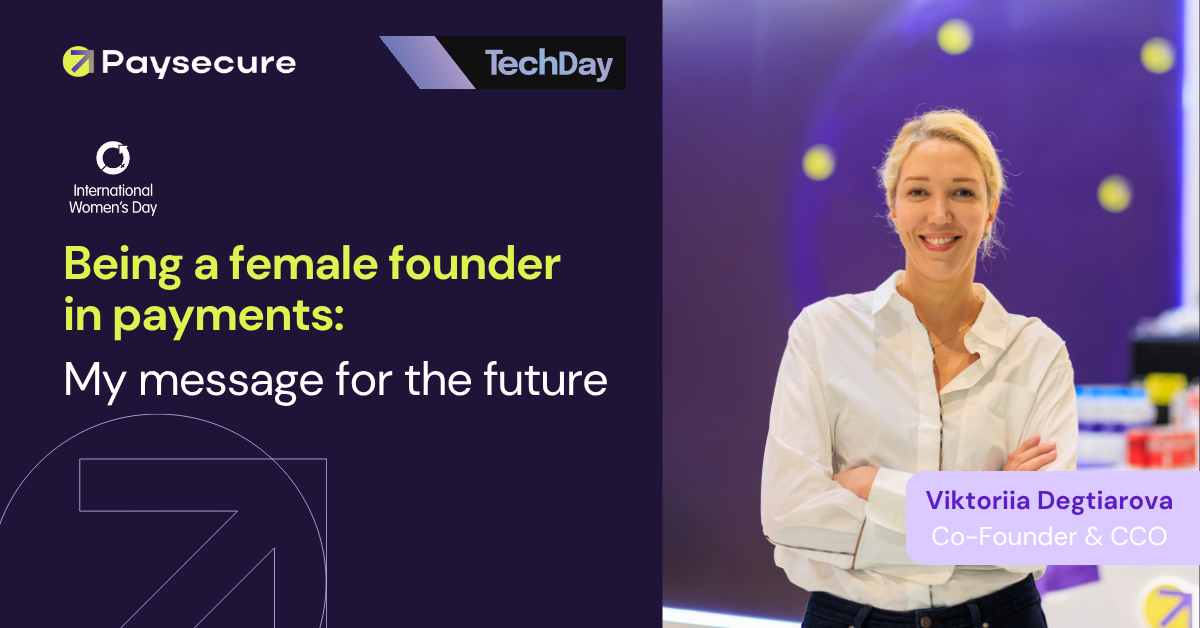
As we celebrate International Women’s Day 2026, the theme of inclusion takes on a profound resonance in the fintech world. When I look back at the journey of co-founding Paysecure, I am reminded that being a woman in the payments industry – specifically within complex sectors and in emerging markets – is not just about navigating a male-dominated room, it’s building a solution in global industries where clients are not properly catered for.
The challenge: Female visibility in a complex payments world
The primary challenge for any woman co-founding a payments business is the credibility tax. In the early days of my career, despite possessing the technical expertise and market insight, I often felt the need to prove my capabilities more extensively than my male counterparts.
In complex sectors, which involve massive transaction volumes, complex cross-border regulations, and the constant threat of fraud, the industry’s default profile has historically been male. I felt, particularly early in my career, that I had to work harder to be taken seriously.
As a co-founder, you aren’t just managing a product; you are managing the perceptions of the person sitting across the table from you. You are often the only woman in the room discussing smart routing, cascading logic, or the nuances of Brazilian transactions, feeling that you have to work harder than the men there to prove your position.
But these challenges are precisely what sharpen us. That’s why at Paysecure, we strive to understand all the requirements of our clients both now, and in the future when they scale. This turns the complexity of the market into our greatest strength. We didn’t just want to participate in the market; we wanted to close the innovation gap between online businesses and emerging markets they want to enter.
The opportunity: Empathy as an engineering tool
While the challenges are real, the opportunities for women in the payments sector are unprecedented. Complex doesn’t mean dangerous; it just requires more work to understand different market contexts, risk-mitigation strategy, and how to provide the best solutions for our customers. The diversity of perspectives, which includes gender, age, backgrounds, and more, helps us answer our clients’ questions from every perspective.
We are also at an interesting crossroads where AI use and complexity is increasing while humans are less involved in the process. For me, the two need to work together to deliver the best results for our clients.
For example, at Paysecure, our User Trust Score and Dynamic Cashier are results of understanding that behind every transaction is a human user, so we pair our expertise in human behavior with deep AI technology to provide the data to our customers to understand their users better.
Our understanding of human behaviour comes from our diverse talent in the business. No human is the same, we all have different behaviours, and therefore, diversity is our strength in providing our clients with the best solutions for their customers.
This diversity spreads to geographic diversity as well. Complex sectors often thrive in exotic locations or in emerging markets, from LATAM to Africa. These markets require more than just a tweak in the code; they require cultural intelligence to build a solution unique to that location and the customers there. Women, who often excel in collaborative networking and holistic problem-solving, are uniquely positioned to lead the expansion into these markets.
I have always believed that knowledge, not gender, should be the primary currency. However, as a woman in a leadership role, I have seen firsthand how mentorship can accelerate a company’s success. By fostering an environment where we value people over protocols, we have built a team at Paysecure that is 131% larger than it was a year ago, with women leading key departments from Marketing to Account Management.
My message for the future
As is the case with many sectors, your network is net worth. No matter where you’ve come from, put yourself out in the sector you want to be in. Get to know people, and take opportunities when they present themselves. Don’t be scared to fail and when you have the experience, pass it on to the next generation so the same barriers don’t need to be broken twice.
To the women looking at the payments sector today, my message is do not be intimidated by the label. Complex payments and its infrastructure is where the most significant innovation is happening. It is where you can build solutions that actually change how people in under-banked regions access the global economy.
My journey from dreaming of a 360 payments empire to co-founding a platform that serves hundreds of countries has taught me that persistence is the ultimate equaliser. This International Women’s Day, my message is simple: Don’t wait for the industry to change, build the technology that makes the old industry obsolete. Build and nurture your network and pass on your experience and knowledge to the next generation. The future of payments isn’t just secure and intelligent; it is diverse.