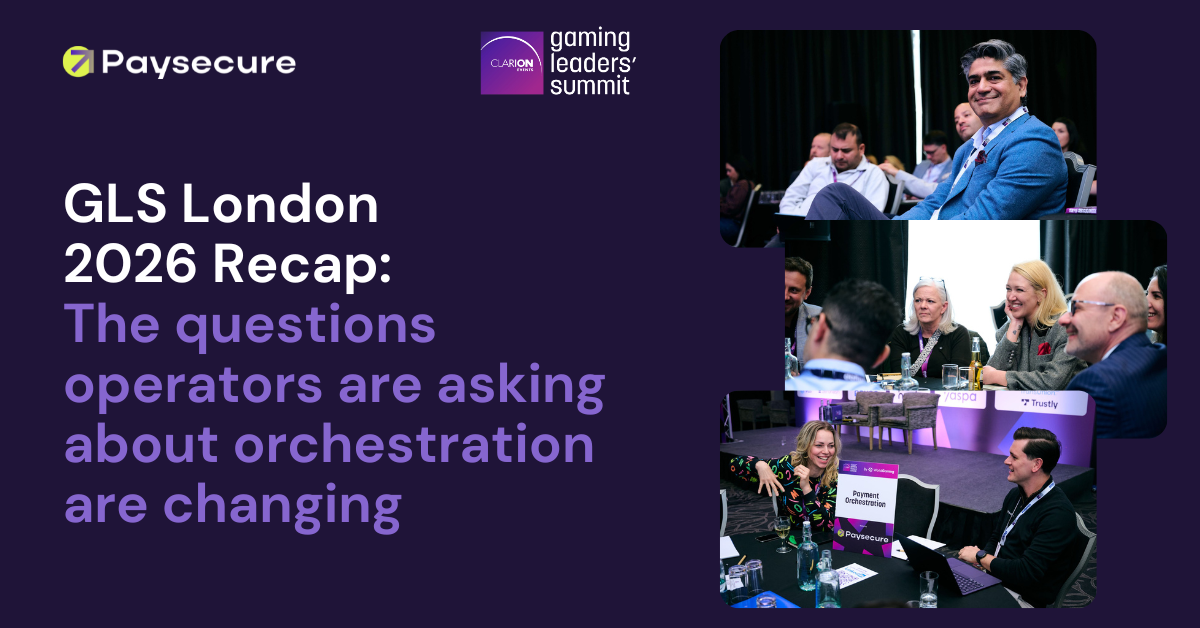
At the Gaming Leaders’ Summit in London this year, the Paysecure team hosted two operator roundtables and joined conversations across the agenda including a session focused on the future of the payments tech stack. The event hosted operators spanning multiple stages of growth and digital maturity, from global brands such as Evoke, PokerStars, Lotto24, and Entain to mid-sized teams preparing to re-platform within the next year. The operators we spoke to spanned very different stages of growth, from businesses scaling a digital offering in an established European market to teams focused on modernising infrastructure, expanding into new markets, and improving player experience at scale.
Earlier this year, we attended Gaming Leaders Summit Madrid, where the orchestration roundtable centred on what payment orchestration could do: revenue uplift, multi-provider resilience, faster market entry. Our recap of that event captured the conversation in full. In the months since, that conversation has moved on. Operators are no longer asking whether they need orchestration. They are asking sharper, more commercial questions: how it should perform, what it costs them not to have it, and where it should go next.
Once an operator stops debating whether to orchestrate, what does a strong payment setup actually look like? Across our conversations in London, a few consistent answers emerged.
Operators have stopped asking whether to orchestrate
The clearest shift since Madrid was the starting point of every conversation. Operators are no longer questioning whether they need orchestration. They are questioning how flexible, responsive and commercially impactful the orchestration layer actually is.
That is a meaningful change. It moves orchestration out of the category of new technology to evaluate and into the category of infrastructure to get right. The bar has risen accordingly. Operators now expect an orchestration layer to be flexible and agile, to operate with real-time insight, and to react to market changes, PSP issues and operational needs at the speed their own business moves.
The payment strategy gap is really an alignment gap
A recurring theme in the roundtable discussions was that most operators do not yet have a concrete payment strategy. This is rarely a failure of effort, and more often it is structural. Payments touches finance, product, technology and risk, and each function comes to it with different priorities and goals. Cross-functional silos leave payment decisions fragmented, with no single owner holding a clear position on when to add another PSP directly and when to route a region through an orchestrator.
This is where orchestration earns its place beyond routing. Designed well, it connects teams rather than just transactions, giving finance, product and risk a shared, real-time view of payment performance. It turns a set of separate decisions into one coordinated strategy.
It is also why operators increasingly value a partner over a platform. Across both roundtables, the pain point that carried was responsiveness. Operators expect a provider that reacts quickly when something changes, whether that is a market shift, a PSP issue or an operational need, and one that can help guide, align and integrate payments across functions. Emerging markets expertise carried particular weight here. Access to local payment methods matters, but operators valued an equally deep understanding of local ecosystems, routing logic and risk management just as highly.
Build versus buy was never binary
Madrid framed build versus buy as a live debate. In London this discussion shifted to how operators actually decide, and the answer is rarely all or nothing. Running in-house payments alongside an orchestration layer, split by market or by brand, is common practice. When one operator expressed surprise that hybrid setups were so widespread, the rest of the table found it unremarkable.
The harder question is not whether to buy, but what to buy. Operators described weighing integrations against the cashier against rules-based routing they cannot replicate in-house. The decision is about identifying a specific need, not making a blanket commitment to orchestrate everything at once.
Cost belongs in that decision, but not in the way the industry usually frames it. Operators in the second roundtable were direct about it. The hidden cost of an in-house stack is not the transaction fee. It is the staffing required to maintain API updates, build integrations and track provider changes. Those costs sit outside most management reporting, they compound, and they rarely appear in a build-versus-buy comparison. Reducing that overhead is a major reason operators turn to orchestration. The value is not only access to multiple PSPs through one integration; it is removing that quiet maintenance burden, and gaining aggregated, real-time insight across the whole platform in its place.
The shift from processing to intelligencel
For locally licensed operators in particular, the next demand is a stronger data layer around payments. The interest has moved beyond processing, and beyond simply collecting historical player data. Operators want actionable, behavioural intelligence: predictive models for churn, chargeback risk scoring, VIP probability and bonus abuse, built on payment and player behaviour data. AI and automation were discussed in the same practical register, not as future concepts but as operational tools already earning their place in routing, monitoring, fraud prevention and reconciliation.
This intelligence reframes what agility means. Agility is not only adding more PSPs. As the panel on the payments tech stack made clear, the cost-per-transaction conversation often misses the point. Cost matters, but performance for the customer is what wins. The changes that move the needle are frequently small: moving a button in the cashier, testing a new payment method, adjusting a routing rule. None of these require a months-long transformation, and behavioural intelligence is what tells an operator which small change to make.
The reasoning is straightforward. Payment failures damage trust, retention and lifetime value. A multi-acquirer strategy spreads that risk, and proactive internal alerts mean a team can act on a problem before a player ever notices it. Operators want global support, but a global footprint still has to feel local to the customer.
The conversation is evolving in the right direction
The throughline across the roundtables and the panel was consistent. In iGaming, payments is being treated as a commercial discipline, and the conversation is evolving in the right direction. Operators are asking better questions about strategy, cost and intelligence, and increasingly recognising that they do not have to answer them alone.
That is where the right specialist partner matters: saving operators time, reducing cost, and building payment performance that compounds over the long term. Paysecure would welcome the chance to continue these conversations with any operator thinking through the same questions.