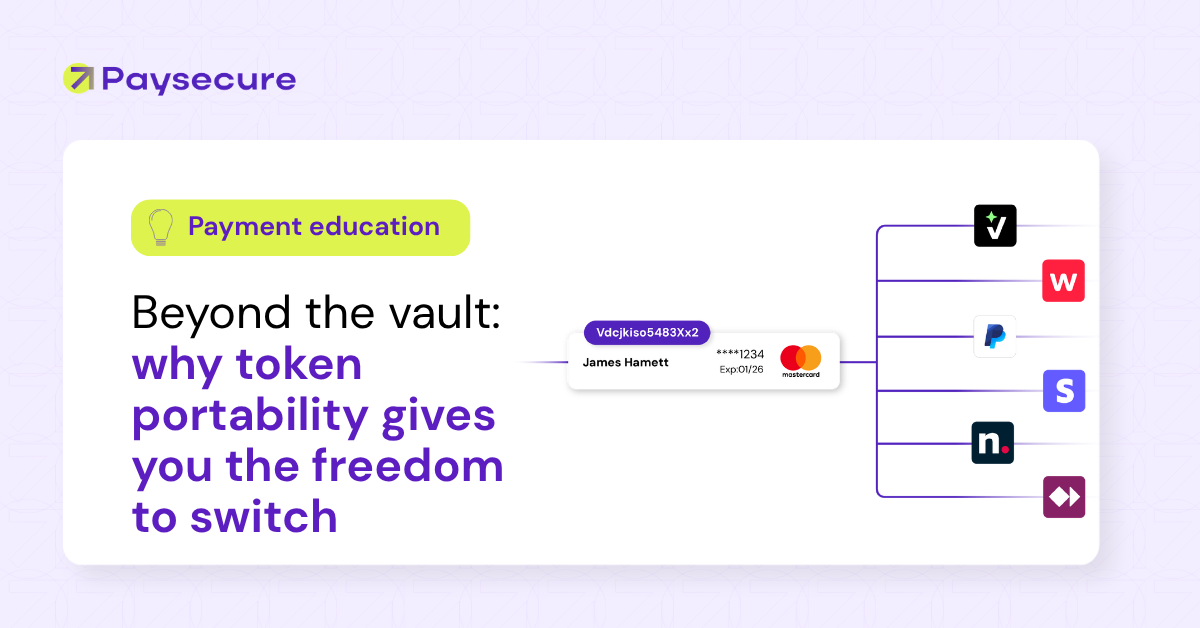
Ask a merchant why they haven’t switched payment providers, and the answer isn’t always price or performance. It is often the complexity of moving years’ worth of stored customer payment credentials from one provider’s vault to another. Where your payment tokens live, and whether they can move with you, can have a far greater impact on your payment strategy than many merchants realise.
In our previous Tokenisation 101 article, we explored what payment tokens are and how they help protect sensitive card data. This article looks beyond security to the commercial value of tokenisation, exploring who owns your tokens, whether they can move with you, and why that flexibility matters.
To a customer, every tokenised payment looks the same. Behind the scenes, however, not all tokens are created equal. As your business grows, adds new payment providers or expands into new markets, the type of token you use can determine whether your payment strategy enables growth or limits it.
Why the type of token matters
Not every token is created equal. The key differences come down to two things; who owns it, and where it can be used.
- Gateway or PSP tokens are generated and held by a single payment provider. They work well within that provider’s environment, but they’re generally not portable to another provider and typically don’t update automatically when a customer’s card is reissued.
- Network tokens are issued by the card networks themselves. They replace the card number throughout the transaction lifecycle and are automatically refreshed by the issuing bank when a customer’s card expires or is replaced, helping to maintain payment continuity.
- Merchant tokens are generated for the merchant and owned by the merchant. This gives merchants the flexibility to use them across multiple channels and link them to more than one acquirer.
When used together, network and merchant tokens provide both portability within a merchant’s own payment environment and interoperability across the wider payments ecosystem. It’s a powerful combination that gives you greater flexibility, keeps commercial options open and makes it easier to adapt as payment strategies evolve.
The case for network tokens
Network tokens deserve particular attention because they solve problems that can have a direct impact on your revenue. As they’re kept up to date by the issuing bank, they reduce failed payments caused by expired or reissued cards. This is especially valuable for subscription businesses, recurring billing and any returning-customer payment flow. Combined with network-level validation and a unique cryptogram for every transaction, network tokens can also improve authorisation rates while reducing fraud.
For merchants with a large volume of stored payment credentials, this translates into higher approval rates, fewer interrupted customer journeys and stronger retention. It’s also where the payments industry is heading. Mastercard has outlined its ambition for network tokens to become the default, with a goal of tokenising all e-commerce transactions by 2030. In addition, Visa has also reported meaningful improvements in authorisation rates and fraud reduction for tokenised card-not-present transactions.
How merchants end up locked in
Vendor lock-in rarely happens overnight. It builds gradually as more and more customer payment credentials are stored and tokenised within a single provider’s vault. Once a large customer base is tied to that provider, switching can mean re-tokenising every stored credential, a process that carries genuine risks, including failed payments, disrupted subscriptions and customer churn.
There are many reasons why you may want to add or switch payment providers; including negotiating better commercial terms, improving acceptance in a specific market, building redundancy to reduce reliance on a single provider, or expanding into new regions. The real question is whether your token strategy gives you the flexibility to make those changes, or leaves you locked into decisions made years earlier.
Why this matters now
For a long time, a single payment provider and its proprietary tokens were enough for most merchants. That is now changing, and quickly. Running multiple providers has become standard practice as merchants look to improve authorisation rates, build resilience, support local payment methods and optimise costs. A token strategy that only works within one provider’s ecosystem no longer reflects how modern payment operations are designed.
Several trends are driving this shift. Margins are under pressure, making it increasingly important for you to negotiate better commercial terms or switch providers without the cost and complexity of moving stored payment credentials. Global expansion adds another layer, with new markets often requiring local acquirers, regional payment methods and market-specific optimisation. At the same time, the card networks are accelerating the move towards network token-first payments, making network tokenisation less of a future consideration and more of an industry standard.
Payment flexibility is becoming a competitive advantage, and token portability is a key part of making that possible.
Portability and interoperability in practice
When payment credentials are stored in portable, merchant-owned tokens, adding or switching providers becomes a configuration change rather than a complex re-platforming project. That gives you the flexibility to choose the providers that best support your commercial goals, whether that’s improving acceptance, reducing costs, building redundancy or expanding into new markets.
It’s also what makes true payment orchestration powerful. Intelligent routing, automated retries and real-time payment optimisation all rely on the ability to move transactions, and the credentials behind them, seamlessly across providers. Portability is the foundation that enables those capabilities, giving you the freedom to adapt your payment stack as your business evolves rather than being constrained by the decisions of the past.
Tokenisation is a commercial decision, not only a security one
Tokenisation sits alongside some of the biggest decisions you make about your payment stack. It influences authorisation rates, resilience, the freedom to switch providers, and the ability to optimise payment performance over time. When treated as a strategic part of a your payments infrastructure, tokenisation becomes the foundation for greater flexibility, stronger commercial control and long-term growth.
At Paysecure, centralised tokenisation is supported by a PCI-compliant token vault, designed to keep payment credentials protected while ensuring you retain control of your payment data.
Choosing the right token strategy
The most important question is not whether you’re using tokenisation, but whether your tokens are working for you. Do they give you the flexibility to switch providers, expand into new markets and optimise your payment strategy over time, or are they tying your business to a single provider? Understanding the answer today can make all the difference when your payment needs change tomorrow.
If you’re reviewing your token strategy, we’re always happy to help. Get in touch with the Paysecure team to explore how our tokenisation solutions can help you protect payment credentials, retain control and build a more flexible payment infrastructure.