Scaling a business means scaling its payments, and sooner or later most teams face the same question. Should you build your own payment orchestration layer in-house, or buy one from a provider? For most the honest answer is buy, but it depends on your situation, and getting it wrong is costly in time, money and missed growth.
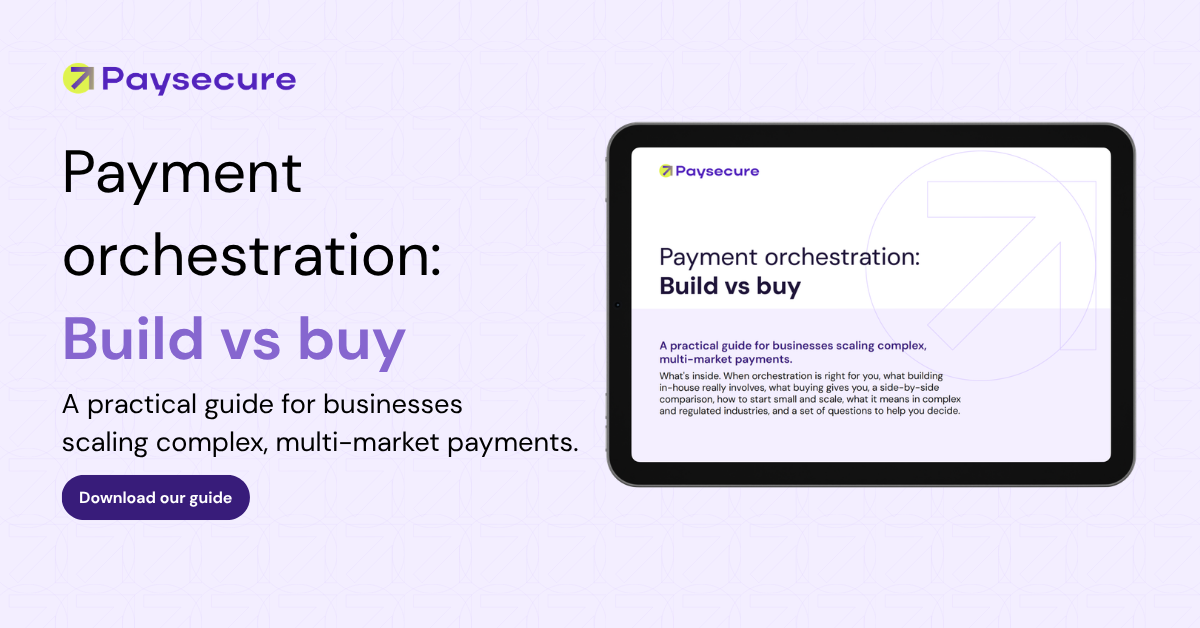
This blog is a short, practical article to help you review the debate. For a deeper, step-by-step walkthrough, our downloadable build vs buy guide goes further.
Setting the scene
In short, payment orchestration is an independent layer that sits above your gateways, acquirers and providers and routes every transaction along the best path for your goals. As more businesses scale across markets and payment methods, regulation changes and customer expectations grow, the build-versus-buy debate for payment orchestration has moved to the top of the agenda. If you are new to the topic, start with what is payment orchestration. The rest of this piece focuses on the debate.
So why has this become such a live question? A few forces have converged. Regulation keeps shifting from market to market, raising the cost of getting compliance wrong. Businesses increasingly need broad ecosystem connectivity, both to keep pricing competitive and to build in redundancy, so a single provider outage does not stop payments. The digital landscape is more competitive than ever, customers expect their preferred local payment methods, and every expansion into a new market brings new providers, methods and rules. Orchestration emerged to manage exactly this complexity, which is why how you adopt it, build or buy, now matters so much.
What building in-house really involves
There is a real upside to building. You get full control of the roadmap, a solution tailored to your exact needs, and you own the intellectual property. For a small number of businesses, that is decisive. For most, the costs that follow outweigh it.
- Cost: an in-house platform demands serious, ongoing investment in hardware, data storage, security and specialist people. The infrastructure and data-management costs in particular are easy to underestimate and tend to grow over time.
- Time and obsolescence: building takes a long time, and payments move fast. A platform designed for today’s needs can be out of date by the time it launches.
- Talent: you need specialist payments engineers, and every hour they spend on payment infrastructure is an hour off the product that actually differentiates you.
- Compliance: PCI DSS and evolving card-scheme and regulatory mandates are a permanent, in-house responsibility.
- The data blind spot: an in-house build can miss valuable data because it lacks deep integration across the full range of PSPs and methods. Industry research from Paysafe suggests over 30% of e-commerce finance teams do not receive detailed payments data, leaving them without key insights.
A note on numbers. Build cost and timelines vary widely by scope, so any figures here are illustrative rather than benchmarks. As a rough guide often cited in the industry, a first build can take well over a year to reach a usable version, with significant ongoing cost after that. The downloadable guide breaks the full cost picture down in more detail.
What buying gives you
Buying orchestration is not a compromise on control; it is a way to get more from your providers, faster. The advantages are consistent.
- Modular and agile: because you take only what you need and add more as you grow, you get both speed and depth of scope. You go live quickly, then expand without re-building.
- Expertise, handled: the provider keeps pace with scheme changes, regulation and new methods, so you do not have to.
- Lower total cost: shared across many merchants, a provider spreads the development and maintenance cost that you would otherwise carry alone.
- Intelligence and reach: one integration connects you to a large network of providers, with reporting and analytics that turn every transaction into insight, the kind of data that levels the playing field with much larger competitors.
The downloadable guide expands on each of these, including a dedicated view for iGaming and other complex, regulated industries.
Build vs buy: a side-by-side view
A feature-by-feature comparison of the two approaches.
| Factor | Building in-house | Buying orchestration |
| Control and IP | Full control; you own the IP. | Configurable to your goals; provider owns the platform. |
| Time to live | A year or more (illustrative, depending on investment and hiring). | Weeks. |
| Upfront cost | High; hardware, people, infrastructure. | Low; no large capital outlay. |
| Ongoing maintenance | Yours, continuously. | Handled by the provider. |
| Expertise needed | A dedicated payments team. | Minimal; the provider brings it. |
| Compliance | Your responsibility (PCI DSS, mandates). | Largely offloaded to the provider. |
| Scalability | Re-engineered as you grow. | Modular; add markets and methods as needed. |
The honest case for building
Building can be the right call in specific circumstances, for example when payments are genuinely your core product or a direct revenue line, when your volume is high enough to justify the investment, when you have deep payments talent in-house, and when you have the time to wait. If that describes you, building deserves a serious review. For almost everyone else, buying gets you there faster and cheaper, with less risk.
You do not have to choose everything at once
Build versus buy is often framed as all-or-nothing. In practice, modern orchestration is modular, so you can start where the need is greatest and expand from there. Many businesses begin with a single market or a specific challenge, improving acceptance in a new region, or adding failover for resilience, prove the value, then widen the rollout. You solve today’s problem without committing to a wholesale rebuild, and you grow into the rest. You can see this approach in action in our smart routing and orchestration case study.
Where the case for buying is strongest
The more complex your payments, the more buying makes sense. In high-volume, high-stakes and multi-market industries, such as iGaming, travel, marketplaces and subscriptions, the challenges stack up quickly, with multiple providers, cross-border complexity, demanding regulation, sharp peaks in volume and a low tolerance for downtime. These are exactly the conditions orchestration is built for, and exactly where an in-house build struggles to keep pace.
How Paysecure payment orchestration is empowering merchants
This is where a focused, independent provider earns its place. Paysecure brings the full orchestration stack together through one integration: AI-driven smart routing that sends each transaction down the best path, cascading and failover that protect revenue when a provider fails, a dynamic cashier with behavioural analytics, and deep reporting that closes the data blind spot an in-house build can leave behind. As our platform is independent, routing is optimised around your goals rather than ours, and because it is modular, you can start with your sharpest challenge and scale from there.
Connected to 500+ PSPs and acquirers with no platform fees, and live in weeks rather than years, Paysecure gives mid-sized businesses the same tools the largest players use. Operators using Paysecure typically see acceptance rise by up to 7%. You can see the impact in our smart routing and orchestration case study.
Questions to help you decide
There is no single right answer, but these questions point you in the right direction.
- Are payments your core product, or a way to grow it? If they are a means to growth, buying usually wins.
- Do you sell across multiple markets or providers, now or soon? The more complex your setup, the stronger the case to buy.
- How quickly do you need to be live? If it is weeks rather than quarters, buying is the realistic route.
- Where are your engineers best deployed? If the answer is your product, let a provider run payments.
- Who should carry compliance and maintenance? Buying hands most of it to the provider.
- How much do you value independence and the freedom to switch providers? A good orchestration layer protects both.
Build for the product, buy for the platform
The build-versus-buy question really comes down to focus. If payments are your product, build. If payments are how you grow the product, buying gets you further, faster, and keeps your team on what makes you different. Whichever way you lean, the goal is the same, payments that drive growth rather than absorb it.
| Go deeper: our downloadable build vs buy guide takes you through the full decision step by step, with a view for iGaming and other complex industries, an illustrative cost breakdown and a set of questions to work through. Download the build vs buy guide. New to orchestration? Start with what is payment orchestration. Common questions are answered on our FAQs page. |